after the blizzard

If the shovel stuck in that fresh white fall it was for the great heavy hunks pushed aside by the only vehicles on the road that day. The unsullied powder comes lightly, lifted from the pile to be moved. Wind blusters by, dusting off the top layer, to send the minuscule flakes sparkling glittery across the blank new surface of the world. Only in the repetitive motion does the body tire from hefting this fluff. Until the shovel sticks against a grimy cake of roadside slush that come uneasily free from the pillowy heaps it has bolstered. Here, the shoulders, breast, and back grow weary. We ask the legs to do work besides that of shuffling, wading through the un-density of freshly fallen blizzard, packing it in the slog.

There is nothing but the heat of our exertion now, breath to melt the whole refrigerated world. The shovel and the body in repetitive vigor, working wisely in a rhythm efficient, deliberate. Haste will not get us through anything called cyclone. Hurry does not serve a body whose work is far from finished. Three feet down until the solid ground, sometimes more. Sometimes bolstered in hunks brought by engined shovels, their lights blinking as if this was an emergency. Is it? The world around is silent in its three-foot new blanket, our effort unseen.

In the morning all the human homes will have similar trenches dug, by different bodies, other machines. A topside, sunshined world of warrens. The emergency lights stop scraping past after the day breaks, welcoming a sky so clear one wonders how the world went white, and whether its reflection could cause sunburn. Nothing more falls, and so the paths we’ve dug, narrow and piled high on the sides, become a delightful part of home. Here we are just animals, tunneled out against natural forces, basking in the sun and cold. The sugared glory of new-fallen snow.

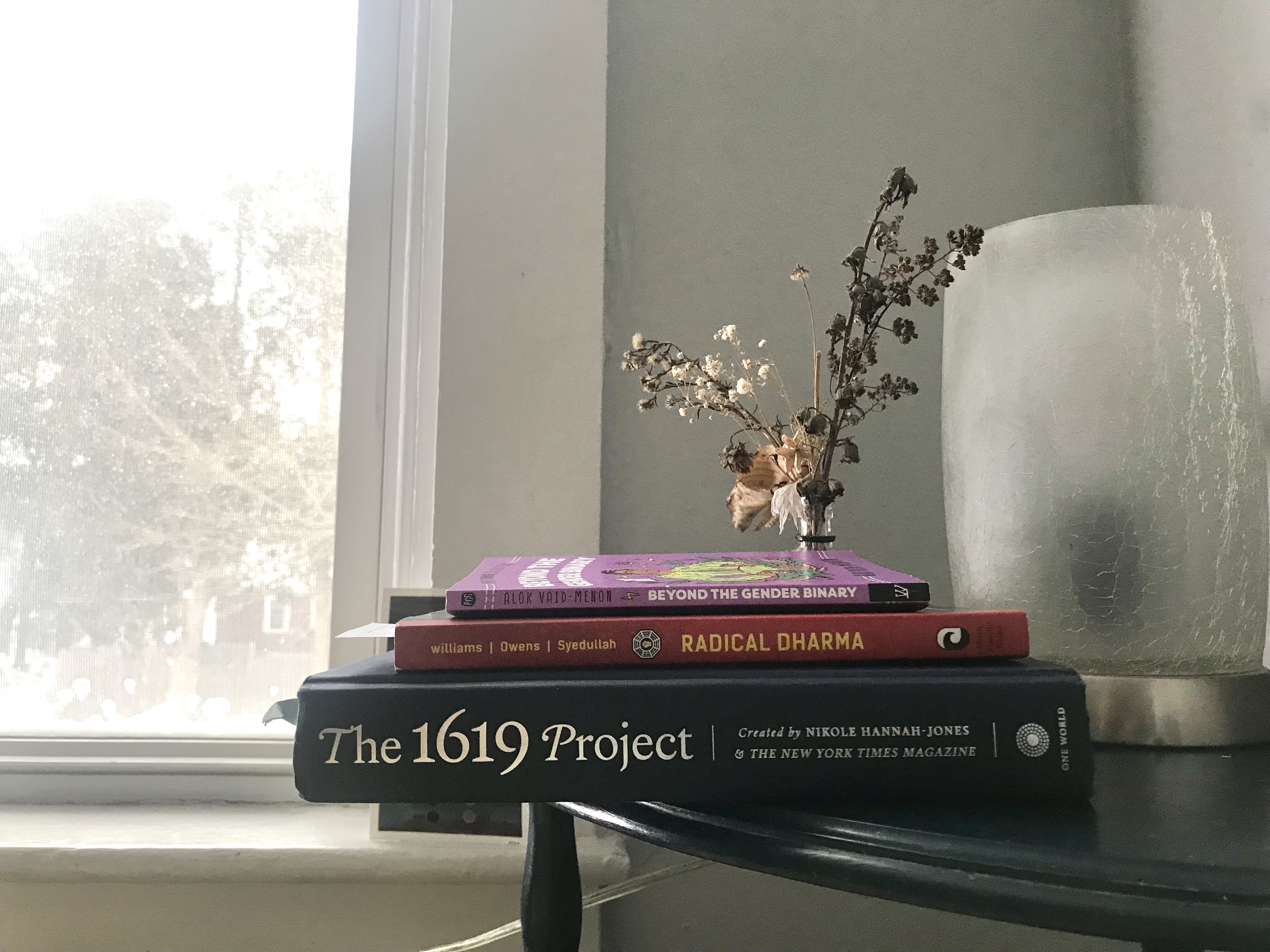
Liberation Trifecta

Or, why I haven’t been writing as much.

These three books are filling gaps in my world that I hadn’t realized I’d been avoiding. They answer, finally, questions I started asking in elementary school.

The genuine optimism conveyed by a more accurate history of this colonial country has been as much a surprise as it is a new strength. I cannot explain entirely why reading of such hardship and often horror has brought me nothing but hope. But I have found that an honest history is the beginning of liberation. Now we will know all of our ancestors’ stories, not just the stories of those who have dominated. For this I couldn’t be more grateful. (The 1619 Project created by Nikole Hannah-Jones)

My fundamental arguments against the eightfold path have been responded to, and wonderfully. Finally, a buddhist practice that offers to address righteous anger. Here now we have made room for those who would not be monks sitting alone on mountains, but rather who engage in activism, who fight for freedom. Those who would extricate themselves in real time, in the real world, that we might turn back and offer our hand to the next. (Radical Dharma from Rev. angel Kyodo williams, Lama Rod Owens, and Jasmine Syedullah, PhD)

The intertwine of my own freedom with that of every other human is a gift, not to be untangled but celebrated. If brevity is the soul of wit, maybe palatable concision is the heart of freedom. This little book has all the best tools for the gender conversation that will liberate us all. (Beyond the Gender Binary by Alok Vaid-Menon)

independence day

I went to a party on the fourth of July. I could give a shit about the holiday, but the party was being hosted by a respected colleague of one of my best friends, with whom I was staying in Chicago at the time. Of course, the party was way out in the suburbs. These folks were white, rich, and, as I was warned along the ride through multiple toll booths and corn fields, voted for Trump. Indiana looked exactly how I’d expected Indiana to look.

We arrived to a gated community where the houses were almost on top of each other, so crowded were they inside their fencing. There was remarkably little lawn or garden space, though these folks clearly adored their home improvements. There was some kind of water somewhere, maybe a man-made lake, which I guess made the neighborliness worth it to folks. Notably few of the houses looked the same, though most could have easily housed multiple families. The one we arrived to had two BMW motorcycles in the garage and a giant hole in the backyard that the owners kept apologizing for. The pandemic had stalled their pool, unfortunately for everyone. Not thirty feet away from our hosts’ hole though was the neighbors’ pool, which we were welcome to if we’d like. It was full of exactly the folks you expect. At some point I was drunkenly ushered into the neighbors’ home and found myself asking someone’s grandmother, “Why am I in this house?” Capitalists will show off their homes to literally anyone.

I was by far the most alternative person between these two backyards, and while I wasn’t particularly welcomed, I wasn’t directly made to feel unwelcome either. Thank goodness for our gracious hosts, who genuinely did seem delighted to have us. I can honestly say I enjoyed their company as well–it was a party, after all. I was determined to have fun, even if it meant being alone with my best friend on the dance floor, ignoring a lot of critical eyes, and singing along to classic rock. Of course this all explains why, later that night, I was still drunk enough to get out of the car and dance on the pavement while we were stopped in massive tollbooth lines headed back into Chicago. There was a lot of honking, and some cheering, also a lot of people pretending not to notice, which seemed weird. Between the two tollbooths I made friends though, and was even offered a shot. It was maybe 10PM: Chicago never lets me down.

A couple of hours before this hilarious and harmless yet disorderly conduct, the man of the house, an older Gen Xer who I’ll call Todd, had brought out his best tequila for us. The vocal admiration between my dear friend and this man had begun quite professionally, almost bashfully, upon our arrival. I was even lucky enough to be pulled aside by Todd and told of my friends’ distinct ability in her field; further, that she was far too humble. (The latter was news to me like, fifteen years ago.) As the afternoon waned, the two honorable colleagues were gradually, amusingly, becoming a sappy mess. Eventually, tequila toasts were in order.

It was over these drinks that it was brought to my attention, not for the first time, that the progeny of our hostess, let’s call her Becky, was seventeen, living under their roof, and had announced a pronoun preference that Becky wasn’t interested in. “It’s so silly, he wants to be called ‘they’!” She proclaimed, “Is ‘she’ next?” I found it charmingly idiotic that Becky would think for a second that I would be sympathetic to her case, yet here she was, looking at me with the conspiratorial eye roll of “you get it”. Todd had casually brought it up to me much earlier, equally more soberly, and seemed to genuinely seek my opinion. My sweet friend, having too-often witnessed my irascibility in our younger years, overheard Todd’s words and expertly steered us toward safety. I certainly appreciated her, but later found myself, having been alerted by Todd so much earlier, glad to be unruffled by Becky’s fresh outburst. Now, confused by my head-shaking denial of her truth, Becky was starting to wonder about the whole thing. “What does it even mean?” she whined. There was no steering the conversation at this point, try as anyone might. I realized, consciously working not to judge Becky too harshly, that it was now or never.

Todd, for his part, was watching me closely. It seemed he had been waiting for this, knowing his wife as he did. For the record these two were fabulously enamored with each other; I had never seen a poster-sized wedding portrait above a headboard before. To some degree they may still have been in the honeymoon phase, and it was cute as hell. We were discussing a child Todd had known only a few years, but clearly cared for. Although he talked around it stiffly, it was obvious that the new step-dad was feeling deeply unqualified right then. Todd was honestly flummoxed. Becky, however, was at her wit’s end. She ranted some and then looked to the rest of us for approval, finding little support. “All teenagers are annoying,” I said. Becky, reaching, took this as vindication. Todd knew better: he physically leaned in. I was beginning to understand what drove my friend in her loyalty to him. This was my moment.

Across the patio table and an empty bottle of mezcal, I looked into the eyes of this pampered pair and said, more quietly now, “Do you love this kid?” Becky rolled her eyes again, feeding into her own exasperation, as Todd said clearly, “Yeah, of course.” This got his wife’s attention–you really can’t blame her for being slow on the uptake after however many shots–she was trying now. I had both of them trained on me as I said, as clearly as I could, “Then this is not the hill you want to die on.” I could see the reflection of a mic-drop in Todd’s eyes. Gratified, I looked to Becky, who hadn’t heard me. She huffed as I continued, “It doesn’t matter to you half as much as it matters to them, and it’s not hard.” Then I swung for the fences: I gestured around us, to their future pool and back toward their stupidly large house. “I refuse to believe that people who have come as far as you, are this successful, and happy,” I let my voice trail off as Becky beamed, “I refuse to believe the people I’ve met here today aren’t intelligent enough to change their language for somebody they love.”

Ultimately, both parents admitted that they didn’t want to lose this kid’s trust over something as trivial as grammar. That doesn’t mean they didn’t use masculine pronouns the entire time, or that they’ll adjust at all. It also doesn’t mean that things will necessarily get easier for any member of that family. All I can share is that it seems if one pays attention, they might seize many moments, strange and sundry, to foster revolution. And on that day, despite our differences, a good time was had by all.
Coming out

Dear loved ones,

I had planned a tour of telling all of you in person this winter, but life planned differently. And so, an email. A friend pointed out that this actually gives everybody more space to acclimate to the whole idea, which I hope is helpful. A few of you receiving this are already in the know, as it were, but I couldn’t leave you out. It has taken me weeks to write; finally sending this on the weekend that celebrates the man who dreamt we’d be judged solely by the content of our character seems about right.

You all knew little “tomboy” Kiah. I can recall many moments growing up when femininity encroached on my ideas of myself in ways I couldn’t then comprehend. You were witness to this confusion, whether explicit or not. I am so glad you’ve known me all along.

I discovered quickly that I was very strange compared to my peers, not to mention wholly confused by the expectations placed on me. I only first realized I wasn’t doomed to be a pariah when I got lucky enough to spend time producing The Vagina Monologues. In that theater was my first opportunity to see that a different world existed—a queer world in which I could maybe actually be what was in my heart. That experience literally saved my life in high school, although it would still be a long road to admitting, standing in, and finally being proud of, my truths.

I have been out as a queer person for a little while now (and that took long enough!) but it has been trickier to claim my lack of gender. I have been afraid to upset anyone, afraid of insistence on my womanhood, afraid of anyone prioritizing comprehension over love. Lately here in Maine, I am grateful to be feeling free and held enough to be proud of my truth. I hope you’ll be proud of me, too.

There’s a lot of research you can do on this, if you are so inclined, but it’s not necessary. This is a unique journey for each person who claims it, and I welcome any and all of your questions. Ultimately though, your love for me might preclude your desire to understand. I hope it will not hurt you to do this thing I ask, as it can only help me.

I no longer use feminine pronouns. They/them/theirs is the language I use to describe myself. I apologize for the inconvenience this causes all of us. The thing about changing our language is that we will all slip up, and that can feel uncomfortable. I still make mistakes in feminizing myself, which feels not great. Of course, most of you have been using “she/her” pronouns about me for longer than I have! Habits are hard to break, but it is in the trying that I will see your heart. And I will love you, trust you, and feel so much safer with you, for that effort.

I am your sibling, child, nibling (alternative for niece/nephew), in-law, step-family, cousin. We are calling me “Uncle” for the little ones, cuz it sounds nice with Kiah, and feels good to me as a genderless person.

The bcc is for your privacy only, as I do hope you’ll reply, discuss, and share your experience, as you please and on your own time. Again, I will gladly answer any questions. I won’t be offended—you’re my family. Lastly, I have included helpful—and fun!—media below.

I love you, Kiah

If nothing else, please listen to this: via Spotify, on Apple podcasts, or you can watch the conversation on youtube. The brilliant and poised interviewee of this podcast, Alok Vaid-Menon, has also written a really short book entitled Beyond the Gender Binary. Every single thing they say and do makes me feel like a world that welcomes me is possible.


NPR also wrote a guide


More indirectly to my personal experience, the HBO show “Sort Of” and the third season of “Sex Education” on Netflix bring lightheartedness to heavy subjects, including being nonbinary. These aren’t pushing a queer agenda, but illustrating humans as we are: unique, flawed, scared, and better when we love each other with our ears wide open.

blue balls, but make them heart-shaped

Thinking inwardly of how silly it had been, given our current circumstances and the trust lost between we two, I told them casually that I’d carried a torch for a while. To look up at their stricken face was beyond surprising, “Oh,” they said, “oh no that would never have happened. I’m so sorry, but I have never thought that way about you.”

That this statement registers unkind was not my first impression. Instead I wondered how this person tends to their own heart. What is a crush if not appreciation, a flutter in the chest, an uncomplicated joy? To what sentiment do we owe an apology? How did they presume I had been injured by not knowing they didn’t share my sweet sentiments?

It has been several months since this conversation took place, and still I wonder. Still I hold cute crushes in my chest, and a singular, deep love in my heart for one I cannot have. None of these are grievances, regardless of the future. They are instead warm, well-lit joys to which I secretly tend, with neither hope nor anguish. Should desire be so painful as to require an apology when unsatisfied? Perhaps the intention was indeed cruel; perhaps patriarchy is to blame. In either case, the flame was long cold before I spoke of it. Only this curious conversation remains.